

Master industry terms in luxury retail for market success
Luxury retail operates in a world where words carry weight and precision matters. Newcomers often struggle with specialized terminology that industry veterans use effortlessly, creating communication barriers that can cost opportunities and credibility. Understanding the language of luxury retail transforms confusion into confidence, enabling you to engage authentically with customers, interpret market trends accurately, and position your business strategically. This guide clarifies essential terminology across product classifications, sales strategies, branding concepts, and pricing frameworks that define success in luxury retail today.
Table of Contents
- Understanding Foundational Terms In Luxury Retail
- Key Sales And Pricing Terms Shaping Luxury Retail In 2026
- Specialized Branding And Market Positioning Vocabulary In Luxury Retail
- Applying Industry Terms To Enhance Customer Engagement And Market Insight
- Explore Exclusive Designer Footwear With Expert Knowledge
Key takeaways
| Point | Details |
|---|---|
| Foundational terms define product categories | Designer label, haute couture, ready-to-wear, and capsule collection establish product hierarchy and market positioning. |
| Sales vocabulary shapes pricing strategy | MSRP, markup, seasonal sales, and clearance events require careful management to preserve luxury brand perception. |
| Branding language builds customer connections | Brand equity, heritage, exclusivity, and prestige pricing communicate value and differentiate luxury from mass market offerings. |
| Terminology mastery improves communication | Using precise industry language enhances customer trust and positions you as a knowledgeable retail professional. |
Understanding foundational terms in luxury retail
The foundation of luxury retail communication rests on precise vocabulary that distinguishes premium products from ordinary merchandise. A designer label represents more than a brand name; it signifies creative vision, quality standards, and market positioning that command premium pricing. This designation separates recognized fashion houses from generic manufacturers and establishes customer expectations before purchase.
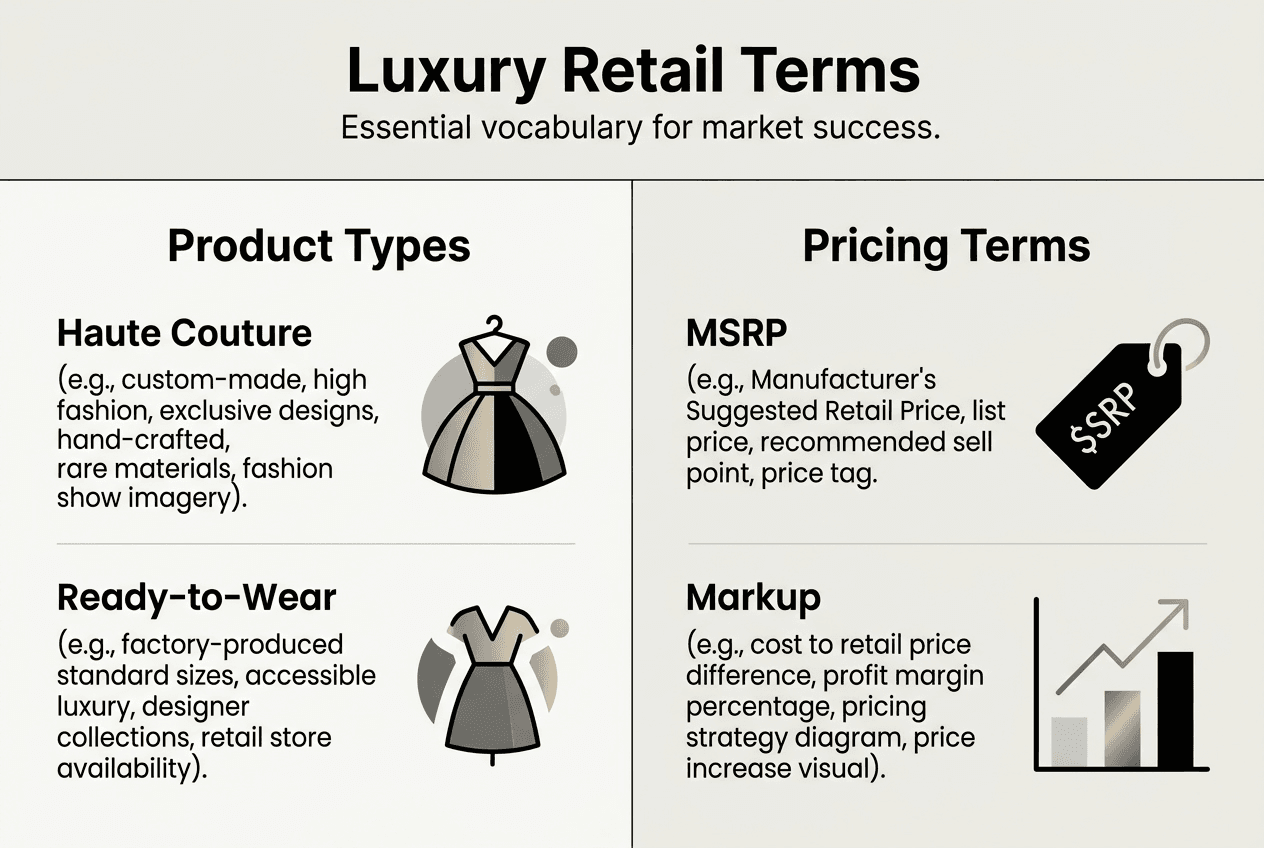
Product categories in luxury retail follow a clear hierarchy. Haute couture represents the pinnacle of custom-made fashion, created exclusively for individual clients with hand-sewn construction and exceptional materials. Ready-to-wear collections offer luxury designs in standard sizes, making designer fashion accessible while maintaining quality standards. Capsule collections feature limited-run pieces designed around specific themes or seasons, creating urgency and exclusivity that drive customer engagement.
Quality indicators communicate craftsmanship and value to discerning customers. Artisan craftsmanship describes handmade techniques passed through generations, while limited edition signals scarcity and collectibility. These terms justify premium pricing by highlighting the skill and time invested in each piece.

Material terminology adds another layer of sophistication to product descriptions. Exotic leather refers to rare animal skins like python or crocodile that command higher prices. Silk blends combine natural fibers for specific performance characteristics. Hand-stitched construction demonstrates attention to detail that machines cannot replicate.
Key foundational terms include:
- Designer label: Brand recognized for creative vision and quality standards
- Haute couture: Custom-made fashion with hand-sewn construction for individual clients
- Ready-to-wear: Luxury designs produced in standard sizes for broader market access
- Capsule collection: Limited-run pieces centered on specific themes or seasons
- Artisan craftsmanship: Handmade techniques demonstrating traditional skill and expertise
- Limited edition: Restricted production quantities creating scarcity and collectibility
- Exotic leather: Rare animal skins commanding premium pricing
- Silk blends: Natural fiber combinations engineered for specific characteristics
- Hand-stitched: Manual construction showcasing meticulous attention to detail
Key sales and pricing terms shaping luxury retail in 2026
Pricing vocabulary forms the backbone of luxury retail strategy and customer communication. MSRP (Manufacturer’s Suggested Retail Price) establishes the baseline price point that brands recommend for their products. Wholesale price represents the cost retailers pay to acquire inventory, while markup calculates the difference between wholesale and retail prices. Price elasticity measures how demand responds to price changes, a critical consideration for luxury brands where perceived value often matters more than cost.
Sales events in luxury retail require strategic naming and positioning. Seasonal sales align with fashion calendars, clearing inventory to make room for new collections. Flash sales create urgency through limited-time offers that drive immediate action. Private sales offer exclusive access to valued customers, reinforcing loyalty and exclusivity. Clearance events move remaining inventory at deeper discounts but must be managed carefully to avoid damaging brand perception.
Discounts and clearance sales require careful calibration in luxury retail. Excessive discounting erodes brand equity and trains customers to wait for sales rather than purchasing at full price. Strategic markdown timing preserves margins while maintaining brand prestige. The challenge intensifies in 2026 as customers grow more price-conscious yet still expect luxury experiences.
Pro Tip: Structure your sales calendar to avoid training customers to expect constant discounts. Reserve deeper markdowns for end-of-season clearance while using private sales and exclusive previews to reward loyal customers without publicly advertising discounts.
Essential sales and pricing terms:
- MSRP: Manufacturer’s recommended baseline price for retail products
- Wholesale price: Cost retailers pay to acquire inventory from brands
- Markup: Percentage difference between wholesale cost and retail price
- Price elasticity: Measurement of demand sensitivity to price changes
- Seasonal sale: Inventory clearance aligned with fashion calendar transitions
- Flash sale: Limited-time offer creating urgency for immediate purchase
- Private sale: Exclusive event offering valued customers early or special access
- Clearance: Deep discount event moving remaining inventory before new arrivals
Specialized branding and market positioning vocabulary in luxury retail
Branding terminology defines how luxury retailers communicate identity and value. Brand equity measures the commercial value derived from customer perception rather than product attributes alone. Heritage references a brand’s history and traditions that build authenticity and trust. Exclusivity describes limited availability that makes products desirable through scarcity. Prestige pricing sets prices above competitors to signal superior quality and status. Brand narrative tells the story connecting products to values and lifestyle aspirations.
Luxury brands follow specific positioning steps:
- Define core values that differentiate the brand from competitors and resonate with target customers.
- Develop visual identity through logos, colors, and design elements that communicate brand personality consistently.
- Craft messaging that speaks to customer aspirations rather than just product features.
- Select distribution channels that reinforce exclusivity and maintain brand control.
- Cultivate customer relationships through personalized service and exclusive experiences.
- Monitor brand perception continuously to protect equity and adjust strategy as needed.
| Aspect | Mass Market Branding | Luxury Branding |
|---|---|---|
| Price strategy | Competitive pricing to maximize volume | Prestige pricing to signal quality |
| Distribution | Wide availability through multiple channels | Selective placement maintaining exclusivity |
| Marketing focus | Product features and promotional offers | Heritage, craftsmanship, and lifestyle |
| Customer relationship | Transactional with limited personalization | Relational with concierge-level service |
| Brand narrative | Functional benefits and value proposition | Emotional connection and aspiration |
Pro Tip: Build your brand vocabulary around authentic stories that customers can verify and experience. Generic luxury language rings hollow, but specific details about craftsmanship techniques, material sourcing, or design inspiration create genuine differentiation that resonates with sophisticated buyers.
What differentiates luxury labels extends beyond price points to encompass the entire vocabulary and positioning strategy that shapes customer perception.
Applying industry terms to enhance customer engagement and market insight
Mastering terminology transforms into competitive advantage when applied strategically in customer interactions and market analysis. Sales conversations become more persuasive when you can explain why a capsule collection offers unique value or how artisan craftsmanship justifies premium pricing. Customers appreciate education that helps them understand what they’re purchasing and why it matters.
Effective communication strategies include:
- Match vocabulary to customer knowledge levels, explaining technical terms without condescension
- Use specific material and construction terms to highlight quality differences between products
- Reference brand heritage and narrative when discussing prestige labels to build emotional connection
- Explain sales event types clearly so customers understand exclusivity and timing
- Connect pricing terminology to value propositions that justify investment in luxury items
- Share market trend vocabulary to position yourself as an informed industry resource
- Translate complex branding concepts into relatable benefits customers care about
Clear use of specialized language elevates perceived expertise and builds customer confidence in your recommendations. When you can articulate why a limited edition piece offers collectible value or how ready-to-wear differs from haute couture, customers recognize your authority and trust your guidance.
Trend analysis becomes sharper when you understand the vocabulary shaping industry conversations. Recognizing when brands emphasize sustainability terminology signals market shifts. Noticing changes in sales event naming reveals strategic repositioning. Tracking how luxury houses describe new collections indicates emerging design directions worth following.
Pro Tip: Create a personal glossary documenting how your target brands use specific terms in their marketing and product descriptions. This reference helps you mirror their language when discussing their products, reinforcing authenticity and demonstrating deep brand knowledge that customers value.
Discounted designer sales require particularly careful vocabulary choices that acknowledge value without diminishing luxury perception.
Explore exclusive designer footwear with expert knowledge
Now that you understand the terminology defining luxury retail excellence, experience these concepts through curated designer footwear that exemplifies quality craftsmanship and timeless style. Our collection showcases pieces where artisan techniques meet contemporary design, offering the exclusivity and prestige that sophisticated customers expect.
Discover elegant gray leather ankle boots featuring hand-finished details and premium materials. Explore elegant black bordeaux striped leather dress shoes that demonstrate the refined aesthetic luxury brands cultivate. Browse chic metallic gray leather pumps showcasing the design innovation that defines designer labels. Each piece represents the quality standards and brand values this guide has helped you understand and articulate.
FAQ
What are the most common industry terms in luxury retail?
Designer label, haute couture, ready-to-wear, MSRP, brand equity, exclusivity, capsule collection, and clearance sale represent foundational vocabulary. These terms appear consistently in product descriptions, marketing materials, and sales conversations across luxury retail channels. Mastering them enables effective communication with customers and industry professionals alike.
How do pricing terms like MSRP and markup affect luxury product pricing?
MSRP establishes the recommended retail price that signals brand positioning and quality expectations to customers. Markup determines profit margins by calculating the difference between wholesale costs and retail prices. Pricing terms shape how brands protect value perception while maintaining profitability across different sales channels and promotional periods.
Why is understanding branding vocabulary critical for luxury retailers?
Branding vocabulary enables clear communication of heritage, craftsmanship, and values that differentiate luxury from mass market offerings. Branding language builds emotional connections by articulating what makes products special beyond functional attributes. Retailers who master this terminology position themselves as knowledgeable partners rather than transactional sellers.
What distinguishes haute couture from ready-to-wear collections?
Haute couture involves custom-made garments created exclusively for individual clients with extensive hand-sewing and fittings. Ready-to-wear collections offer luxury designs in standard sizes, making designer fashion accessible to broader markets while maintaining quality standards. The distinction affects pricing, exclusivity, and customer expectations significantly.
How should retailers use sales terminology to maintain luxury perception?
Use terms like private sale and exclusive preview to create urgency without suggesting desperation. Reserve clearance language for end-of-season inventory management rather than regular promotional cycles. Frame discounts as special access opportunities for valued customers rather than price reductions driven by lack of demand, protecting brand equity while moving inventory strategically.