

Limited edition fashion: Why investing in scarcity pays
TL;DR:
- Scarcity and exclusivity increase fashion item value through psychological appeal and cultural storytelling.
- Proven brands and verified production limits are essential for investment potential and value retention.
- Careful research and passion-driven choices help avoid hype-driven purchases and market depreciation.
Limited edition fashion sits at a fascinating crossroads between personal style and financial strategy. While most shoppers focus on the emotional pull of owning something rare, scarcity psychology also activates real financial benefits, from strong resale returns to long-term collection value. Whether you’re drawn to a numbered Hermès piece or a coveted designer collaboration, understanding what actually drives value in limited releases can save you from costly mistakes and help you build a collection that rewards you for years. This guide breaks down the psychology, the numbers, and the practical steps to shop smarter.
Table of Contents
- The psychology of scarcity and exclusivity
- Investment potential: Resale value and ROI
- Risks and realities: When limited editions aren’t worth it
- Smart buying: How to choose limited edition pieces
- What most guides miss: Personal collections, cultural resonance, and real ROI
- Explore curated limited edition deals for your collection
- Frequently asked questions
Key Takeaways
| Point | Details |
|---|---|
| Scarcity drives value | Limited editions activate FOMO and emotional urgency, leading to higher perceived and real value. |
| Smart investments pay off | Iconic limited edition fashion pieces from heritage brands can offer strong resale returns for collectors. |
| Beware artificial hype | Not all limited editions retain value; research provenance and demand before buying. |
| Collect for meaning | Limited editions can enhance collections with storytelling and cultural resonance as well as style. |
| Balance style and ROI | Prioritize authentic pieces that suit your taste and collection goals over short-term trends. |
The psychology of scarcity and exclusivity
There’s a reason your pulse quickens when you see “only 3 left” on a product page. Scarcity equates rarity with value, and FOMO (fear of missing out) creates emotional urgency that pushes buyers to act fast, often before they’ve thought it through. Fashion brands know this well and engineer it deliberately.
Limited edition releases work because they tap into something deeply human: the desire to belong to an exclusive group. When you own a piece that only 500 other people in the world have, it signals taste, access, and cultural awareness. That feeling is not trivial. It shapes how you carry yourself and how others perceive you.
Brands use several mechanics to amplify this effect:
- Numbered releases: Each piece carries a unique number, reinforcing genuine scarcity.
- Time-limited drops: A 48-hour window forces immediate decisions.
- Collaborations: Pairing a luxury house with a cultural icon (artist, musician, designer) creates a story that outlasts the drop itself.
- Regional exclusivity: Items sold only in select cities or boutiques add a geographic layer of rarity.
Understanding exclusivity in fashion goes beyond just wanting what others can’t have. It’s about cultural resonance. A piece tied to a specific moment in art or music history carries meaning that a mass-produced item simply cannot replicate.
“The most compelling limited editions don’t just sell a product. They sell membership in a story.”
Pro Tip: Before buying, ask yourself whether you’re responding to genuine scarcity or manufactured urgency. A truly limited piece has a verifiable production number and a clear cultural or brand narrative behind it.
Some buyers are purely emotionally driven, and that’s valid. Wearing something that connects you to a cultural moment or a designer’s creative peak is its own reward. But pairing that emotional pull with smart research is what separates collectors from impulse buyers.
Investment potential: Resale value and ROI
Limited edition fashion is not just about looking good. The numbers tell a compelling story. According to resale data, Hermès retains 138% of value, and the Louis Vuitton x Murakami collaboration exceeds 130% resale value, outperforming many traditional investments.

Not every limited edition performs this way, but iconic pieces from houses with deep heritage consistently hold their ground. The key is knowing which categories and brands have a proven track record.
| Brand / Item | Avg. Resale Retention | Key Factor |
|---|---|---|
| Hermès Birkin | 138% | Genuine scarcity, heritage |
| LV x Murakami | 130%+ | Cultural collaboration |
| Chanel Classic Flap | 100-120% | Timeless design |
| Hype sneaker drops | 60-80% | Trend-dependent |
Understanding designer handbag value means looking beyond the sticker price. Provenance, condition, original packaging, and documentation all affect what a piece commands on the secondary market.
Here’s how to evaluate investment potential before you buy:
- Research past resale cycles. Check platforms like Rebag, The RealReal, or Vestiaire Collective for historical pricing on the specific item.
- Verify production numbers. A piece claiming to be limited should have documentation to prove it.
- Assess brand heritage. Houses with decades of craftsmanship behind them are safer bets than newer labels riding a trend.
- Check resale market insights for category trends. Handbags consistently outperform clothing and footwear in resale.
- Consider the collaboration story. Items tied to a specific artist or cultural event tend to appreciate as that figure’s legacy grows.
Pro Tip: Use a high-end resale guide to benchmark pricing before you commit. Knowing the secondary market value before you buy is the single most powerful move a collector can make.
The smartest buyers treat limited edition fashion the way art collectors treat prints: condition, provenance, and cultural context matter as much as the name on the label.
Risks and realities: When limited editions aren’t worth it
Not every limited drop is a smart buy. The Knight Frank Luxury Index showed a 3.3% downturn in 2025, confirming that not all limited editions appreciate. Some lose value quickly, and others were never truly scarce to begin with.
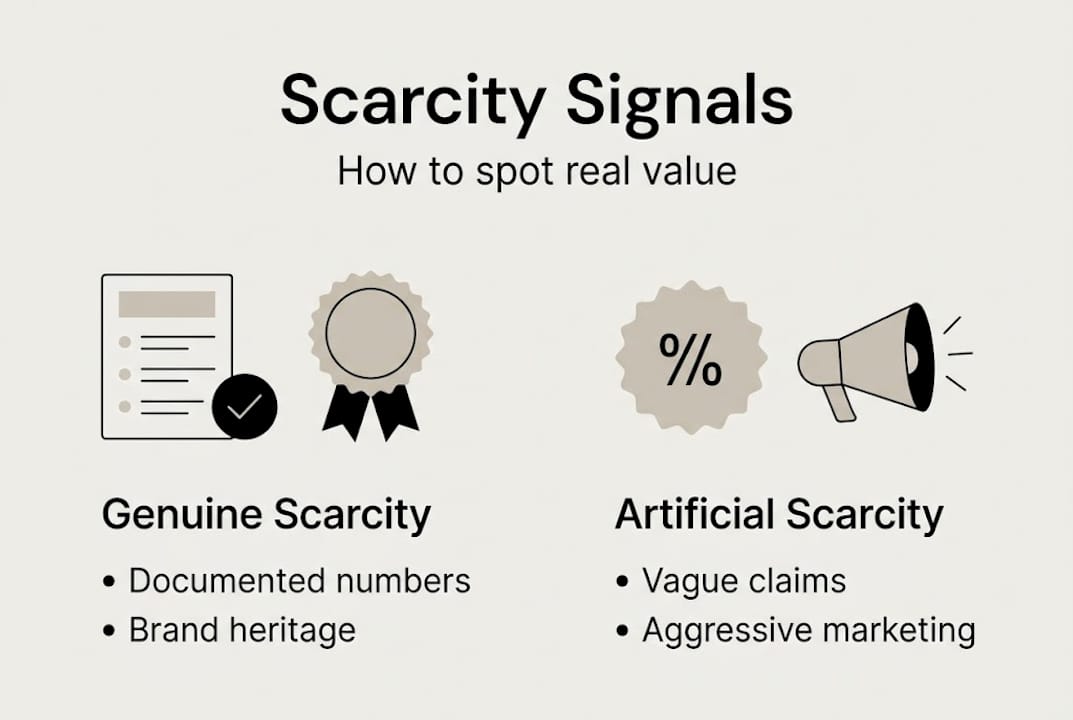
Artificial scarcity is a real problem. Some brands create the illusion of limited supply through marketing tactics while quietly restocking or releasing near-identical versions. When demand wanes, buyers are left holding overpriced items with no secondary market.
Here’s a quick comparison of genuine vs. artificial scarcity signals:
| Signal | Genuine Scarcity | Artificial Scarcity |
|---|---|---|
| Production number | Documented, verifiable | Vague or unverifiable |
| Resale demand | Sustained over time | Drops sharply post-release |
| Brand communication | Transparent, specific | Hype-heavy, vague |
| Secondary market | Active, competitive | Thin or declining |
Beyond financial risk, there are sustainability concerns worth taking seriously. Frequent limited drops encourage overconsumption and fuel FOMO-driven reselling cycles that generate unnecessary waste. Buyers who care about ethical fashion should look at how brands approach sustainable luxury fashion before participating in a drop.
Watch out for these red flags:
- No verifiable production numbers
- Heavy influencer marketing with little brand substance
- Items restocked within weeks of the “final” drop
- No clear cultural or creative narrative behind the release
- Brand with little heritage or craft tradition
Pro Tip: Always check a brand’s reputation and track record before investing in a limited release. A house with decades of craftsmanship behind it is a fundamentally safer bet than a label built on social media buzz.
The emotional sting of missing a drop is real, but buying the wrong piece is far more costly. Patience and research are your best tools here.
Smart buying: How to choose limited edition pieces
Knowing the risks, the next step is building a practical framework for making decisions you won’t regret. Smart buying is about balancing personal style with investment logic, and the two don’t have to conflict.
Savvy collectors prioritize proven icons like Hermès Birkins over hype-driven drops, and for good reason. Icons have demonstrated demand across multiple market cycles. Hype fades. Craft and heritage endure.
Use this checklist before committing to a purchase:
- Confirm the item has a documented production limit
- Research the brand’s resale history over at least 5 years
- Verify authenticity through official channels or trusted resellers
- Assess whether the piece fits your personal style long-term
- Check current secondary market pricing to understand your entry point
Here’s a simple framework for evaluating any limited edition piece:
| Factor | What to look for | Why it matters |
|---|---|---|
| Brand heritage | Decades of craft history | Sustains long-term demand |
| Release mechanics | Numbered or time-limited | Confirms genuine scarcity |
| Cultural narrative | Artist, event, or era tie-in | Drives collector interest |
| Condition/provenance | Original packaging, receipts | Maximizes resale value |
| Personal resonance | Fits your style and collection | Ensures long-term satisfaction |
For deeper research, handbag value insights offer category-specific data that helps you compare options within the same budget. And if you’re newer to this space, a solid fashion bargain guide can help you identify deals that deliver both style and value.
- Start with one iconic category (handbags are the most reliable).
- Set a budget that accounts for potential resale loss.
- Buy only from verified sellers with authentication guarantees.
- Store pieces properly to preserve condition and value.
- Revisit your collection annually to assess market changes.
Pro Tip: The best limited edition buys are ones you’d be happy to keep even if the resale market softened. Personal style and financial value should reinforce each other, not compete.
“The goal isn’t to own everything rare. It’s to own the right things, for the right reasons.”
What most guides miss: Personal collections, cultural resonance, and real ROI
Most buying guides focus on resale percentages and drop mechanics. What they miss is the deeper reason serious collectors keep coming back: limited editions enhance collections through storytelling and personal meaning that no spreadsheet can fully capture.
We’ve seen buyers chase pure ROI and end up with a closet full of items they don’t connect with. That’s a real loss, even if the numbers look fine on paper. The collectors who build genuinely valuable wardrobes are the ones who understand what luxury fashion actually means: a convergence of craft, culture, and identity.
The uncomfortable truth is that hype-driven buying almost always underperforms patient, passion-led collecting. When you buy something because it resonates with your personal aesthetic and has a clear cultural legacy, you’re far less likely to panic-sell during a market dip. That emotional anchor is actually a financial advantage, not a weakness.
Authentic passion and informed research are not opposites. They’re the combination that produces the best outcomes, both for your collection and your investment returns.
Explore curated limited edition deals for your collection
You’ve done the research. Now it’s time to put it into practice. At Designer Label Sale, we curate authentic designer pieces that meet the standards this article outlines: genuine brand heritage, verified authenticity, and real value for style-conscious shoppers.
Whether you’re starting your collection or adding a statement piece, our selection includes investment-worthy footwear like these gray leather ankle boots, refined black bordeaux dress shoes, and the striking metallic gray leather pumps that balance style with lasting appeal. Each piece is sourced for quality and value, so you can shop with the confidence that comes from knowing exactly what you’re buying.
Frequently asked questions
Do limited edition fashion items always increase in value?
No, only iconic items with strong brand heritage consistently retain or appreciate in value. The Knight Frank Index showed a 3.3% downturn, confirming that many hype-driven releases lose value over time.
What makes a limited edition piece valuable?
Genuine scarcity equates rarity with value, but provenance, brand heritage, and sustained secondary market demand are equally important factors in determining long-term worth.
How can I avoid buying hype-driven fashion that loses value?
Research brand reputation, past resale performance, and authentication before investing. Savvy collectors prioritize proven icons like Hermès Birkins over trend-driven drops with no track record.
Are limited edition releases bad for sustainability?
Frequent limited drops can encourage overconsumption and FOMO-driven reselling, raising real sustainability concerns. Buyers should research whether brands address ethical sourcing before participating in drops.
Where can I find authentic limited edition luxury deals?
Trusted curated retailers that specialize in verified authenticity and brand reputation are your best source for limited edition pieces that deliver both style and genuine value.
Recommended
- Exclusivity in Fashion: Psychology, Prestige & Luxury Deals – Designerlabelsale
- Why invest in designer footwear? Unlock value and style – Designerlabelsale
- Unlocking luxury: the real role of fashion outlets explained – Designerlabelsale
- 5 advantages of authentic designer brands: quality and value – Designerlabelsale