

Why Luxury Labels Matter for Modern Style
Finding authentic luxury brands at the right price can feel like searching for a hidden gem in the heart of a busy city. For style-conscious shoppers, luxury labels offer more than status symbols—they represent personal identity and taste elevated into art. This guide unpacks the unique appeal of luxury branding, showing how heritage, craftsmanship, and cultural meaning set these coveted pieces apart and help you make smarter choices for your wardrobe.
Table of Contents
- Defining Luxury Labels And Their Unique Appeal
- Core Types Of Luxury Brands In Fashion
- Key Characteristics: Craftsmanship, Heritage, Value
- Influence On Personal Identity And Social Status
- Financial, Ethical, And Practical Implications
Key Takeaways
| Point | Details |
|---|---|
| Luxury Labels as Symbols | Luxury brands go beyond products, serving as social symbols that communicate status and personal identity. |
| Types of Luxury Brands | The luxury fashion landscape includes haute couture, ready-to-wear, and diffusion lines, each catering to different consumer needs. |
| Craftsmanship and Heritage | Quality craftsmanship and brand heritage enhance perceived value, deeply connecting consumers to cultural narratives. |
| Ethical Considerations | Modern consumers increasingly demand transparency and ethical practices from luxury brands, shaping purchasing decisions. |
Defining Luxury Labels and Their Unique Appeal
Luxury labels represent far more than expensive clothing items they are complex social and cultural symbols that communicate status, taste, and personal identity. Contemporary luxury branding research reveals these brands serve as sophisticated platforms for individual expression that blend personal pleasure with social distinction.
At their core, luxury labels function as carefully constructed narratives that transcend mere material goods. They strategically balance exclusivity with widespread desire, creating products that are simultaneously aspirational and attainable. The unique appeal of these brands lies in their ability to craft intricate experiences that go beyond simple transactions, transforming clothing and accessories into statements of personal philosophy and aesthetic sensibility.
The psychological appeal of luxury labels stems from their multifaceted nature. Academic studies on luxury branding demonstrate how these brands integrate personal identity, social communication, and aesthetic innovation. They are not just selling products but offering membership into an exclusive cultural ecosystem where design, craftsmanship, and individual interpretation converge.
Pro Tip: When exploring luxury labels, focus on understanding the brand’s heritage and design philosophy rather than just the price tag.
Core Types of Luxury Brands in Fashion
The luxury fashion landscape is diverse and intricate, comprising several distinctive categories that cater to different consumer segments and aesthetic preferences. Luxury branding research reveals a complex ecosystem of brands ranging from traditional haute couture to contemporary digital-first labels, each occupying a unique position in the market.
Three primary categories define the luxury fashion brand spectrum. First, haute couture represents the pinnacle of design exclusivity, featuring handcrafted garments created for individual clients with extraordinary attention to detail. Second, ready-to-wear luxury brands offer more accessible designer collections that maintain high quality while being produced in limited quantities. Third, diffusion lines provide entry-level luxury products that democratize designer aesthetics at more approachable price points.
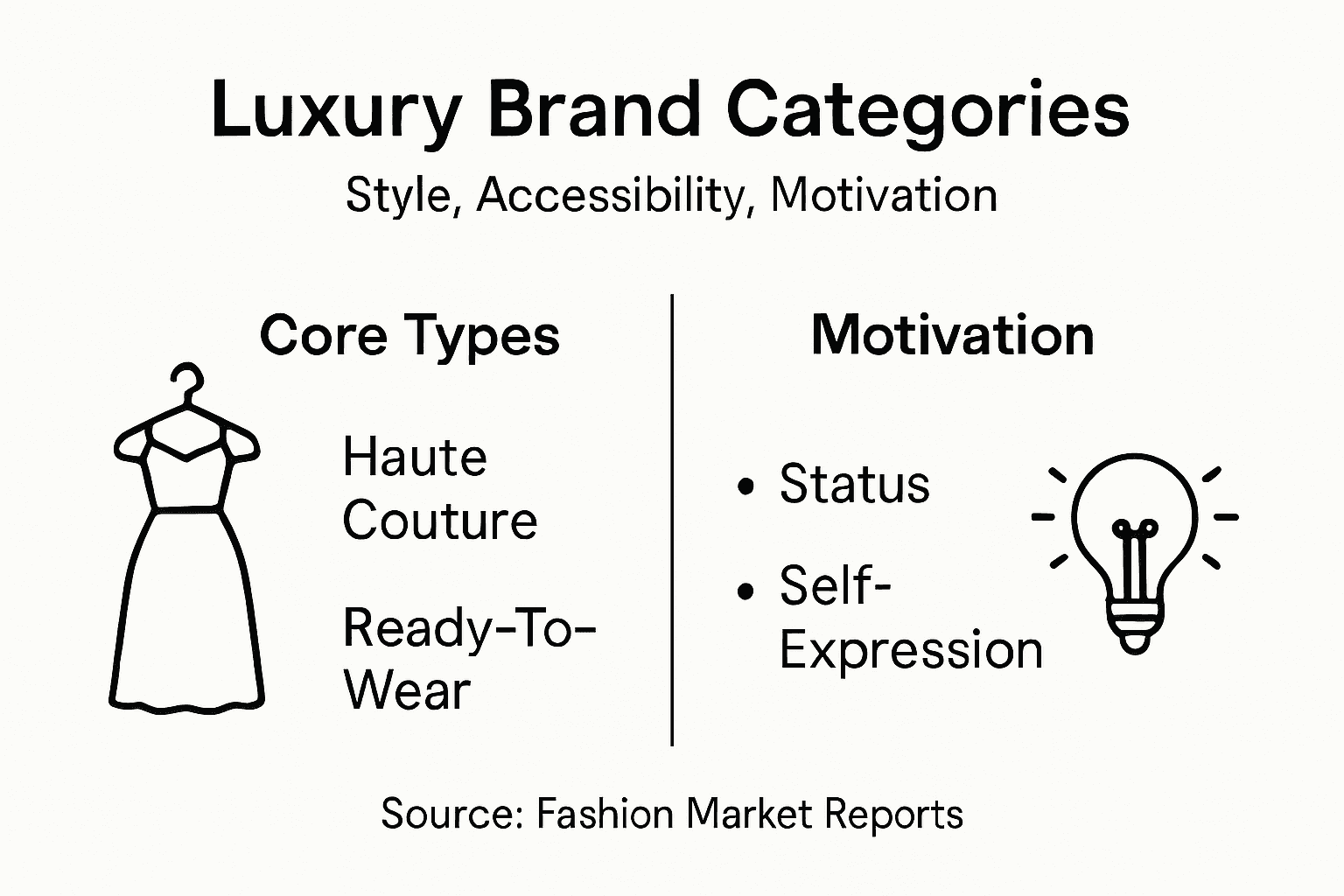
Contemporary luxury brand strategies demonstrate how these brands continuously adapt to technological trends and changing consumer expectations. Digital-first luxury brands are emerging, leveraging online platforms to connect with younger, tech-savvy audiences while maintaining the core principles of exclusivity and exceptional craftsmanship. These brands are reimagining traditional luxury paradigms by integrating innovative marketing approaches and personalized consumer experiences.
Pro Tip: When exploring luxury brands, examine their unique design philosophy and heritage rather than focusing solely on price or trend status.
Here’s a comparative look at the main types of luxury fashion brands and what distinguishes each:
| Brand Type | Design Focus | Accessibility Level | Typical Consumer Motivation |
|---|---|---|---|
| Haute Couture | Custom, hand-crafted pieces | Extremely exclusive | Status, artistry |
| Ready-to-Wear | Limited designer collections | Selective, but more attainable | Quality, trend participation |
| Diffusion Lines | Accessible designer goods | Broadly available | Entry to brand, aspirational style |
Key Characteristics: Craftsmanship, Heritage, Value
Craftsmanship stands as the fundamental cornerstone of luxury fashion, representing an uncompromising commitment to quality that transcends mere product creation. Luxury brand heritage analysis reveals how top-tier brands like Chanel and Hermès transform clothing and accessories into cultural artifacts through meticulous artisanal techniques and extraordinary attention to detail.

The intricate relationship between heritage and value in luxury brands creates a complex narrative that goes far beyond monetary worth. Each stitch, seam, and design element tells a story of generational expertise, with brands carefully preserving traditional manufacturing methods while simultaneously innovating. Artisanal skills become a form of cultural capital, where the provenance of a piece matters as much as its aesthetic appeal, connecting consumers to a rich lineage of design excellence.
Luxury brand distinguishing characteristics demonstrate that true value emerges from the intersection of superior materials, exceptional craftsmanship, and a compelling brand narrative. Modern luxury consumers are not just purchasing a product but investing in a legacy that represents cultural sophistication, individual expression, and timeless quality. These brands create emotional connections by offering more than just clothing they provide a gateway to an exclusive world of aesthetic refinement and personal identity.
Pro Tip: When evaluating luxury pieces, examine the craftsmanship details like stitching, material quality, and design precision to understand the true value beyond the price tag.
Below is a summary of factors influencing luxury brand value and consumer perception:
| Key Factor | Impact on Brand Value | Consumer Perception |
|---|---|---|
| Craftsmanship | Enhances exclusivity | Indicates attention to detail and quality |
| Heritage | Builds cultural significance | Suggests tradition and brand prestige |
| Ethics | Drives modern loyalty | Influences trust and brand image |
| Price | Maintains aura of rarity | Reflects both quality and symbolic status |
Influence on Personal Identity and Social Status
Luxury brand psychological research reveals that luxury brands function as powerful tools for personal and social identity construction, far beyond mere fashion statements. These brands serve as sophisticated mechanisms through which individuals communicate complex social narratives, expressing personal values, aspirations, and social positioning through carefully curated aesthetic choices.
The consumption of luxury brands represents a nuanced form of social signaling, where individual choices become strategic expressions of belonging and differentiation. Social identity theory explains how consumers strategically use brand affiliations to navigate complex social landscapes, creating visual representations of their perceived social status, professional achievements, and personal aesthetics. Each luxury purchase becomes a carefully calculated communication tool, broadcasting subtle messages about personal accomplishment and cultural sophistication.
Social identity projection research demonstrates that luxury brand selection goes beyond aesthetic preferences, functioning as a complex psychological mechanism for group membership and personal differentiation. Consumers strategically leverage these brands to negotiate their position within social hierarchies, using clothing and accessories as sophisticated language that communicates personal narrative, cultural capital, and symbolic boundaries between different social groups.
Pro Tip: Understand that luxury brands are more than products they are powerful tools for personal storytelling and social communication.
Financial, Ethical, and Practical Implications
Luxury sustainability research reveals a complex landscape where financial constraints and ethical considerations significantly impact luxury brand consumption. The emerging paradigm highlights a critical attitude-behavior gap, where consumers demonstrate strong interest in sustainable luxury but frequently encounter practical barriers preventing full engagement with environmentally responsible fashion choices.
The economic dimensions of luxury brands extend far beyond simple transactional relationships, representing intricate negotiations between consumer aspirations and market realities. Luxury brands must strategically balance premium pricing with perceived value, addressing the growing consumer demand for transparency, ethical production, and social responsibility. This delicate equilibrium requires brands to communicate their value proposition clearly, demonstrating that higher prices reflect not just material quality but also comprehensive ethical and environmental commitments.
Luxury market dynamics analysis underscores the nuanced relationship between economic inequality and luxury consumption. The traditional narrative of luxury as a symbol of exclusivity is evolving, with modern consumers demanding more comprehensive accountability. Brands are increasingly expected to demonstrate social consciousness, ensuring their production processes, labor practices, and environmental impact align with progressive ethical standards. This shift represents a profound transformation in how luxury is perceived and valued in contemporary society.
Pro Tip: Evaluate luxury purchases through a holistic lens, considering not just aesthetic appeal but the brand’s ethical practices, sustainability efforts, and long-term value.
Discover Authentic Luxury That Speaks to Your Style and Values
Luxury brands define more than fashion they tell a story of craftsmanship heritage and personal identity as highlighted in the article “Why Luxury Labels Matter for Modern Style”. If you seek designer pieces that offer exclusivity and quality without compromising your budget our collection on DesignerLabelSale provides exactly that. You can enjoy authentic luxury items that align with your aspiration for sophisticated style while engaging in a more accessible and ethically conscious form of consumption.
Explore our wide range of discounted designer clothing handbags accessories and footwear today. Embrace the opportunity to express your individuality and social statement through iconic luxury labels delivered with fast shipping and clear pricing. Visit DesignerLabelSale now and experience how you can own exceptional pieces that balance craftsmanship value and your personal narrative without delay.
Frequently Asked Questions
What are luxury labels and why do they matter?
Luxury labels are high-end brands that symbolize status, taste, and personal identity. They go beyond just expensive clothing by providing a narrative that combines personal pleasure with social distinction.
What types of luxury brands exist in fashion?
The primary categories of luxury brands include haute couture, which offers custom designs; ready-to-wear brands, which provide more accessible luxury collections; and diffusion lines, which democratize designer aesthetics at lower price points.
How do craftsmanship and heritage influence luxury brand value?
Craftsmanship and heritage significantly enhance luxury brands by ensuring superior quality and a rich backstory. Artisanal skills and traditional methods contribute to a brand’s cultural capital, making each piece valuable beyond its monetary worth.
How do luxury brands impact personal identity and social status?
Luxury brands serve as tools for personal and social identity construction. Consumers use these brands to communicate their values, aspirations, and social positioning, using carefully curated aesthetics to signal belonging and distinction within social hierarchies.
Recommended
- Why Designer Pieces Are Worth It – Designerlabelsale
- From Street to Studio: How to Style Designer Pieces for Every Day – Designerlabelsale
- 5 Must-Have Designer Staples That Never Go Out of Style – Designerlabelsale
- How to Score Luxury Fashion for Less – Designerlabelsale
- Role of Accessories in Fashion: Elevate Your Style
- What Is Contemporary Luxury Menswear in the UK? – Vellure Homme